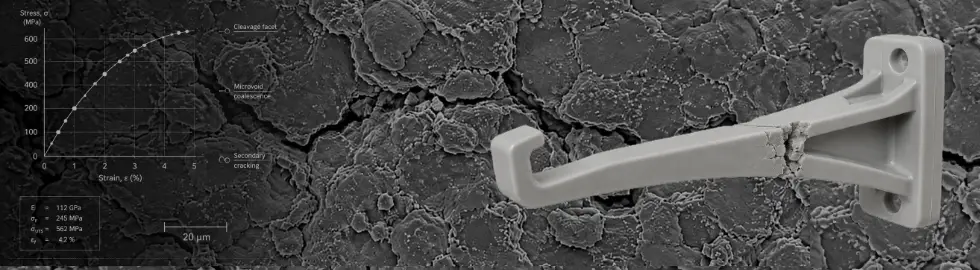
Creep is the tendency of a polymeric material to deform permanently under the influence of constant stress, as applied through tensile, compressive, shear, or flexural loading. It occurs as a function of time through extended exposure to levels of stress that are below the yield strength of the material. Given sufficient time, this can lead to creep rupture, the failure within a material as a result of continuously applied stress at a level below the tensile strength. Plastic materials are particularly prone to creep rupture through exposure to static stresses, and a recent study indicates that 22% of plastic failures are associated with creep.
The relatively high frequency of creep failure is linked to the widespread lack of awareness and understanding of the effects of time on polymeric materials, particularly at the design stage; the unique difference in time dependence between polymeric materials and metals; and the increasing use of plastic materials in diverse applications with longer time demands.
The concept of creep is extremely important to manufacturers and users of plastic components. This course will cover:
Jeffrey A. Jansen is the Engineering Manager and a Partner at The Madison Group, an independent plastics engineering and consulting firm. Jeff is a proven plastic professional with more than 30 years of experience solving problems and addressing opportunities related to polymeric materials. He specializes in failure analysis, material identification and selection, as well as compatibility, aging, and lifetime prediction studies for thermoplastic materials. Jeff has performed over 5,000 investigations, both for industrial clients and as a part of litigation. He is a regular presenter on the SPE webinar series, covering a wide range of topics related to plastics failure, material performance, testing, and polymer technology. Jeff is a graduate of Carroll College and the Milwaukee School of Engineering.
This course is designed for professionals who work with plastic materials and need to understand long-term performance and failure mechanisms, including:
Materials, polymer, and mechanical engineers
Product and design engineers responsible for structural and load-bearing components
Manufacturing and process engineers
Quality, reliability, and failure-analysis professionals
R&D scientists and lab technicians
Technical sales and application engineers
Professionals designing components subjected to long-term loads or service conditions
Why Should You Attend?
Attend this course to gain a practical understanding of creep failure in plastics and how long-term stress, time, temperature, and material behavior influence product performance. Unlike metals, plastics can gradually deform or fail under loads that appear acceptable in short-term testing, making creep one of the most important failure mechanisms to understand when designing or evaluating plastic components. This course will help you connect material properties, service conditions, testing methods, and real-world failure analysis so you can make better decisions in design, manufacturing, quality, reliability, and product development.
Everyday Problems You’ll Address
Creep is one of the most critical yet often misunderstood failure mechanisms in plastics. Unlike metals, polymeric materials exhibit strong time-dependent behavior, which can result in gradual deformation and eventual failure under stresses well below the material’s strength.
This course provides a clear understanding of creep behavior and explains why a significant percentage of plastic component failures are related to long-term loading. It helps bridge the gap between short-term testing data and long-term performance in real applications.
What You’ll Learn
Why did a plastic component fail after long-term service under relatively low stress?
How can I predict long-term deformation and failure of plastic parts?
What factors accelerate creep and creep rupture in plastics?
How do time, temperature, and stress interact in real-world applications?
Why do standard material properties fail to predict long-term performance?
How can I design against creep failure in plastic components?
Why This Course Matters
You will gain a practical understanding of creep and time-dependent behavior in plastics, including:
Fundamentals of creep and viscoelastic deformation
Mechanisms of creep deformation and creep rupture
Differences between short-term mechanical properties and long-term performance
General patterns and models of creep behavior
Methods for creep testing and lifetime prediction
Key variables influencing creep, including stress level, temperature, time, and material structure
Case studies illustrating real-world creep failures and lessons learned
This educational program is provided as a service of SPE. The views and opinions expressed on this or any SPE educational program are those of the Speaker(s) and/or the persons appearing with the Speaker(s) and do not necessarily reflect the views and opinions of the Society of Plastics Engineers, Inc. (SPE) or its officials, employees or designees. To comment or to present an opposing or supporting opinion, please contact us at info@4SPE.org.
Refund Policy
Full refund 14 days prior to the event start date. Please contact customerrelations@4spe.org for assistance with registration.
Copyright & Permission to Use
When you enter a SPE, a division of PLASTICS event or program, you enter an area where photography, audio, and video recording may occur. By entering the event premises, you consent to interview(s), photography, audio recording, video recording and its/their release, publication, exhibition, or reproduction to be used for news, webcasts, promotional purposes, telecasts, advertising, inclusion on websites, social media, or any other purpose by SPE and their affiliates and representatives. Images, photos and/or videos may be used to promote similar events in the future, highlight the event and exhibit the capabilities of SPE. You release SPE, their officers and employees, and each and all persons involved from any liability connected with the taking, recording, digitizing, or publication and use of interviews, photographs, computer images, video and/or or sound recordings. By entering the event premises, you waive all rights you may have to any claims for payment or royalties in connection with any use, exhibition, streaming, web casting, televising, or other publication of these materials, regardless of the purpose or sponsoring of such use, exhibiting, broadcasting, web casting, or other publication irrespective of whether a fee for admission or sponsorship is charged. You also waive any right to inspect or approve any photo, video, or audio recording taken by SPE or the person or entity designated to do so by SPE. You have been fully informed of your consent, waiver of liability, and release before entering the event.
Anti-Trust Statement
No discussion among members, volunteers, or staff, which attempts to arrive at any agreement regarding prices, terms or conditions of sale, distribution, volume, territories, or customers;
No activity or communication which might be construed as an attempt to prevent any person or business entity from gaining access to any market or customer for goods or services or any business entity from obtaining services or a supply of goods;
No activity or communication which might be construed as an agreement to refrain from purchasing or using any materials, equipment, services or supplies of or from any supplier; or
No other activity which violates anti-trust or applicable laws aimed at preventing unfair competition.